
Frequently Asked Questions
If you have any additional questions or need further assistance, you can contact us at 360support@infosight360.com or fill out the the Support Request Form.
Answer: This usually happens when text is copied from a Word document with tracked changes. Although the text appears fine in the editor, the underlying code is retained from Word and becomes visible when printed.
To FIX this issue, highlight the affected text in the editor and click the Remove Formatting tool. Then save and re-print or re-publish your content.

To PREVENT this issue, accept all tracked changes in Word before copying. Alternatively, you can use CTRL + SHIFT + V to paste in the editor as plain text. Both options ensure that Word’s redline formatting is not carried into the system.
Redlined documents can be found in the following places:
- On the Support Site under Content Updates in the left side navigation.
- Model Policies - at the bottom of the policy under Model Content Updates.
- CU Policies - if the policy was previously imported, the redlined document can be found in the editing screen at the bottom under Model Content Updates.
- CU Policies - if the policy was previously imported, the redlined document can be found in view mode - only after editing the policy and saving the policy. Also found under Model Content Updates.
Redlined documents can be found in the following places:
- On the Support Site under Content Updates in the left side navigation.
- Model Policies - at the bottom of the policy under Model Content Updates.
- CU Policies - if the policy was previously imported, the redlined document can be found in the editing screen at the bottom under Model Content Updates.
- CU Policies - if the policy was previously imported, the redlined document can be found in view mode - only after editing the policy and saving the policy. Also found under Model Content Updates.
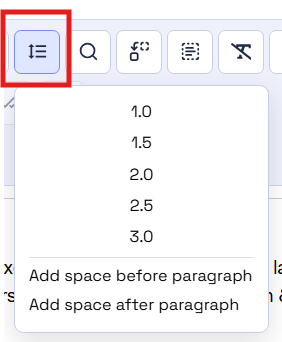
To create a space after a paragraph, sentence or other string of content in the editor, click on the icon (see below) and choose your spacing preference. If you are applying the spacing preference to the entire page of content, you can put your cursor anywhere inside the content editor. If you are applying the spacing preference to a section of content, you will need to first highlight the content, then click on the spacing icon.
The content for both CU PolicyPro and RecoveryPro is written from a federal perspective, so topics that fall under state law are not addressed. Because the laws between states vary so widely, it would be very difficult to write model content that would be meaningful. We recommend checking with your state league/association on state-specific topics.
In addition, CU PolicyPro content typically covers Operational topics. Certain areas such as Human Resources or Board Governance are important and may be touched on within the model content, but we are not generally writing content that cover these areas.
There may be other content your credit union needs that is not found in CU PolicyPro or RecoveryPro. Please feel free to request this content to be added. While we cannot guarantee to write content on any given topic, we do review all requests and fulfill as many as we can.
To find a redlined document for a particular policy, View the model content or go to the editing screen of the associated content in CU Policies or CU BCP. All redlined documents from the past three years for each content section will be linked in the “Model Content Updates” section below the content editor.
To find a redlined document from a particular update, go to the “Content Update Archives” folder on the Resources page for the specific product, then open the folder titled with the month and year of the desired update. If you are looking for an update that is older than those listed, please contact our support team at 360support@infosight360.com.
These issues are generally due to one of two Internet browser settings, The first is a setting which does not allow background images (including highlighted text) to show when printing. The second is a setting that generates headers and footers documents printed from the Internet. Changing these settings depends on which Internet browser you are using. If you are not sure how to change these settings, please contact our support team for assistance.
Note: Browser settings are applied to all documents printed from the Internet on your computer until those settings are changed. Also, browser settings only apply to a particular computer. If a user is printing policies from a different computer, the settings may also have to be adjusted for that computer.
Please send an email to 360support@infosight360.com to notify us of the name change and if your email has changed so we can ensure you receive information and updates related to CU PolicyPro and RecoveryPro.
- For email address changes, you will need to go into your account profile and update your own email address (in the Administration area, click the “My Account” link in the upper right corner of the screen). If you do not have access to the Administration area, any Admin-level user can update your email address for you or our support team will be happy to help. We do not update email address information unless specifically requested to do so as this will affect the user’s log in information.
- Any previously published documents will still have your old credit union name on them. The published documents are point-in-time, so there isn’t any way to update this. You will have to republish in order to see the new credit union name.
- Review the Key Fields and update the [CUname] Key Field, if applicable.
- If you have the credit union name as text in your customized policies (and not as a Key Field), you can use the search bar in the Administration area to see which sections include the credit union name and update accordingly.
Yes, there is a processed called "publishing" which allows you to select any (or all)content from CU PolicyPro or RecoveryPro to be published into a printable document. Published documents can be downloaded to PDF (or Word) and stored externally from the site. Published documents can also be assigned to one or more Roles or to "Any Logged in CU PolicyPro/RecoveryPro User" which limits which users can see the document.
Please note that publishing is a point-in-time process, so once published the document content will not change. If your customized content is updated after being published, you will need to re-publish the document in order to see the changes.
Review the user guides for detailed instructions on publishing content.
Yes, many credit unions use CU PolicyPro to manage their procedures.
The CU Policies area has the flexibility to organize content in hierarchical tiers, such as chapter, policy, and procedure. This allows for a more organized and structured approach to managing your content. The “Content Label” field allows you to specify the content type contained in each section (for instance Policy, Procedure, Appendix, etc)
The most common way of of incorporating procedures is to include them as a sub-section(s) under the overarching policy.
Alternate suggestions for adding procedures:
- Upload procedure documents to the “Resources” folder of the Files management system.
- Create a new chapter for sets of procedures.
There are a few instances where a password change is required:
- As a security measure, passwords are required to change every 90 days.
- When our support team creates a new user or resets a password for an existing user, a temporary password is used and the user will be required to change the password on the next login.
- If the “Forgotten Password” function is utilized, the system will ask the user to change their password on the next login.
If the system is asking you to change your password outside of these reasons, please contact 360support@infosight360.com.
CU PolicyPro model policy content includes a series of Key Fields to assist with the customization of the model policies. The bracketed text is a Key Fields, which is a bit of information needed to complete the customization of the content. An example of a key field would the name of the credit union, or the maximum amount allowable in a teller’s drawer.